Your car is usually a sanctuary of rhythm—the steady hum of the Car Noises, the familiar click of the turn signal, and the soft whirl of the climate control. But then, it happens. You hit a bump or merge onto the highway, and you hear it: a chirp, a groan, a metallic screech, or a rhythmic thud. Your stomach drops. You turn down the radio, lean forward, and wonder, Is this a 50 fix or a 5,000 engine failure?
In the world of “The Corner Wrench,” we believe your ears are your most valuable diagnostic tools. Long before a dashboard light flickers on, your vehicle will often “speak” to you through sound. In 2026, as cars become quieter and more refined, new and unusual noises stand out even more. Ignoring them is like ignoring a toothache—it won’t get better on its own, and it will almost certainly get more expensive the longer you wait.
Whether you are navigating the stop-and-go traffic of Toronto or the open stretches of the Prairies, this Motorz guide will help you translate those mysterious sounds into a clear action plan. Let’s break down the symphony of car noises and what they mean for your vehicle’s health.
Screeches, Squeals, and Chirps: The High-Pitched Warnings
High-pitched noises are often the most Car Noises, but they are also the most helpful because they usually point to specific, accessible components.
The Piercing Squeal During Braking
If you hear a sharp metallic screech every time you apply the brakes, your car is doing exactly what it was designed to do.
The Cause: Most brake pads are equipped with a small metal “wear indicator.” When the pad material gets dangerously thin, this metal tab touches the rotor, creating a high-pitched warning.
The Fix: It is time for new brake pads. Ignore this, and you will move into “metal-on-metal” territory, which means replacing the much more expensive rotors as well.
Squealing Under the Hood During Startup
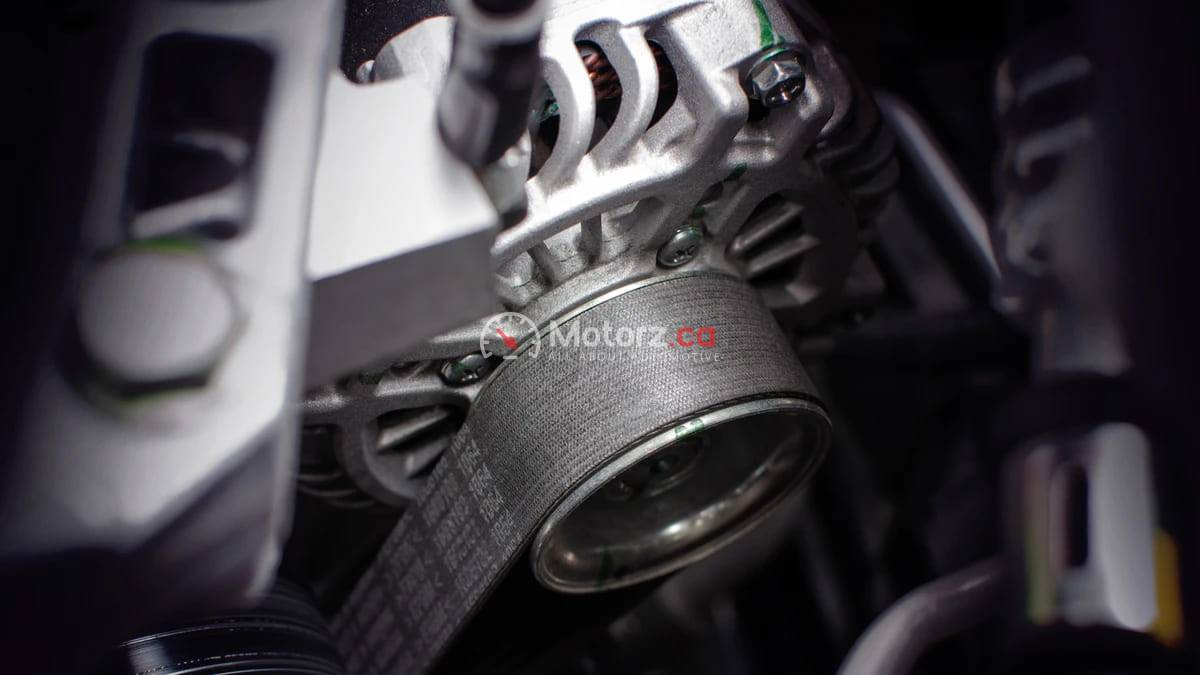
Does your car sound like a bag of angry cats for the first thirty seconds after a cold start? This is almost always related to your serpentine belt.
The Cause: The belt may be glazed, cracked, or simply loose. Cold weather makes the rubber stiffer, causing it to slip on the pulleys until it warms up.
The Fix: Inspect the belt for cracks. In 2026, most belts should be replaced every 100,000 km. If the belt is new, your belt tensioner might be failing.
A Chirping Noise That Matches Engine Speed
If you hear a consistent “chirp-chirp-chirp” while idling, you might have a failing pulley bearing. The water pump, alternator, and AC compressor all rely on bearings to spin smoothly. If one starts to go dry, it will chirp as a warning before it eventually seizes.
Thuds, Clunks, and Rattles: The Suspension Symphony
When the noises come from “underneath” and happen specifically when you hit bumps or turn the wheel, your suspension is trying to tell you something.
The “Hollow” Clunk Over Bumps
If you hit a pothole and hear a sound like a bowling ball hitting a wooden floor, your struts or shock absorbers are likely shot.
The Warning: Beyond the noise, you might notice the car “bouncing” several times after a bump or the front end “diving” excessively when you brake.
The Fix: Suspension components should be replaced in pairs (both fronts or both rears) to maintain balanced handling.
The Rhythmic “Clicking” During Turns
If you are turning into a parking spot and hear a rapid click-click-click that speeds up as you move, look at your CV joints (Constant Velocity joints).
The Cause: The rubber boot protecting the joint has likely torn, allowing grease to leak out and grit to get in.
The Tip: If you catch a torn boot early, you can sometimes just replace the boot. Once it starts clicking, the whole axle usually needs to be replaced.
A Metallic Rattle Beneath the Car
If you hear a light, tinny rattle while idling—especially if it sounds like pebbles in a soda can—it is often a loose exhaust heat shield. These thin metal plates protect your car from the heat of the catalytic converter. They often rust at the mounting points, causing them to vibrate against the exhaust pipe.
Humming, Growling, and Roaring: The Drivetrain Dilemma
These noises are often speed-dependent. They might be quiet at 40 km/h but become a deafening roar at 100 km/h.
The Low Growl That Changes with Direction
If your car has developed a “drone” or “hum” that sounds like you are driving on knobby off-road tires, you likely have a failing wheel bearing.
The Diagnostic: While driving safely on a clear road, gently sway the car left and right. If the noise gets louder when you veer left (loading the right side) and quieter when you veer right, you have successfully identified which side has the bad bearing.
An Engine “Roar” During Acceleration
If your car suddenly sounds like a race car every time you step on the gas, you have an exhaust leak.
The Danger: Beyond the noise, an exhaust leak can allow carbon monoxide to enter the cabin. If the roar is coming from the front of the car, it is likely a cracked exhaust manifold. If it is from the back, your muffler has probably rusted through.
Ticking and Knocking: The Heart of the Matter
Noises coming directly from the engine block are the ones we take most seriously at “The Corner Wrench.”
The Light Tapping or Ticking
A light “tock-tock-tock” that speeds up with the engine is often related to the valvetrain.
The Common Culprit: Low oil level. Before you panic, check your dipstick. Many modern engines use hydraulic lifters that rely on oil pressure to stay quiet. If you are a liter low, they will tick.
The 2026 Reality: Many modern Direct Injection (DI) engines have naturally noisy fuel injectors that produce a constant “ticking” sound. This is normal, but if the sound suddenly gets louder, have it checked.
The Dreaded “Deep” Knock
A heavy, rhythmic thumping from deep inside the engine is often a “rod knock.” This is caused by a failure of the bearings that connect the pistons to the crankshaft.
The Verdict: This is a mechanical emergency. Shut the engine off immediately. Continuing to drive with a rod knock will result in a “thrown rod,” which effectively destroys the engine block.
How to Talk to Your Mechanic
When you bring your car to the shop, being able to describe the noise accurately can save you hundreds in diagnostic fees. Use the Corner Wrench Sound Checklist:
What kind of sound is it? (Squeal, clunk, hum, or grind?)
When does it happen? (During braking, while turning, only when cold, or at high speeds?)
Where does it seem to come from? (Front, back, left, or right?)
Does it change? (Does it get louder with engine RPM or with vehicle speed?)
At Motorz, we want to keep your “automotive ears” sharp. Most major repairs start as minor noises. By listening closely and acting early, you ensure your car stays a sanctuary of rhythm rather than a symphony of expensive problems.