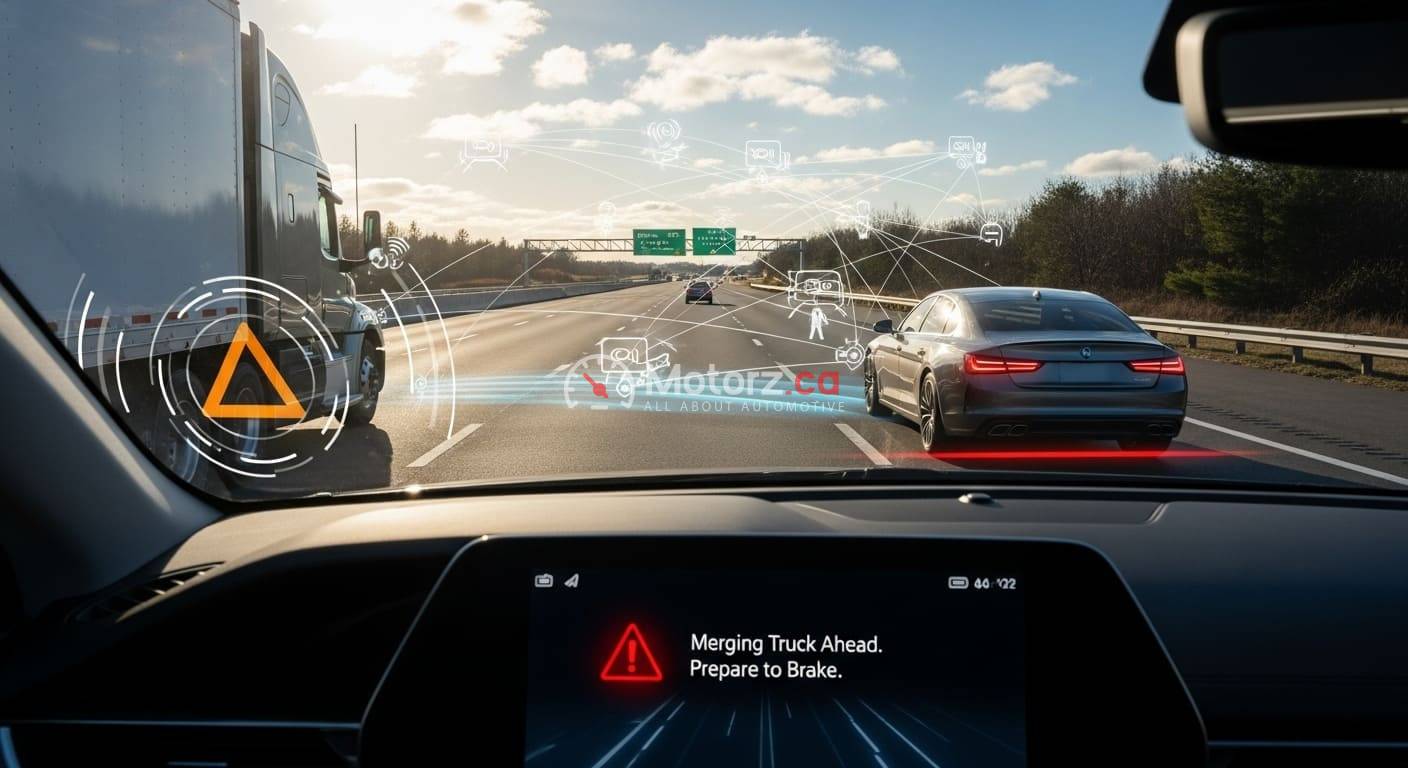
The sheer volume of Prevent Accidents in North America fatalities and serious injuries on North American roads represents a devastating cost to society, both human and economic. Traditional vehicle safety systems—seatbelts, airbags, and even camera-based Advanced Driver-Assistance Systems (ADAS)—are largely reactive, mitigating damage after a hazard is detected. But a profound shift is underway, moving from systems that react to those that anticipate. This shift is powered by Vehicle-to-Everything (V2X) communication, a technology poised to fundamentally rewrite the rules of road safety in the United States and Canada.
V2X is the digital language of the Prevent Accidents in North America, allowing a vehicle to talk to everything around it: other vehicles, traffic signals, infrastructure, and even pedestrians. The goal is simple and monumental: to leverage real-time information exchange to eliminate the human errors responsible for the vast majority of collisions. Research has consistently indicated that widespread V2X deployment could prevent up to 80 percent of non-impaired driver accidents. While full deployment will take until 2030 and beyond, the pivotal Prevent Accidents in North America, regulatory, and technological milestones being achieved in 2025 are anchoring this massive transition.
This post delves into the science of V2X, explores its key applications, examines the critical technological decision made in North America, and outlines the roadmap for how this connected future will finally make Vision Zero—the goal of eliminating all traffic fatalities—a reality.
Decoding V2X: The Prevent Accidents in North America
Vehicle-to-Everything (V2X) is an umbrella Prevent Accidents in North America for wireless communication technology that links a car to its entire environment. Unlike on-board sensors (like radar and cameras) that are limited by line-of-sight and weather, V2X operates through dedicated radio spectrum, providing a 360-degree awareness that extends hundreds of meters, even around blind corners or through traffic.
The Four Pillars of V2X
V2X communication is broken down into four essential components, each contributing a distinct layer of collision avoidance:
V2V (Vehicle-to-Vehicle): Car-to-car communication is the Prevent Accidents in North America. Vehicles continuously broadcast basic safety messages (BSMs) containing their speed, location, direction, and braking status. A car detects a collision threat from a vehicle it cannot yet see (e.g., one speeding through a blind intersection) and instantly alerts the driver or the automated system.
V2I (Vehicle-to-Infrastructure): Vehicles communicate with roadside units (RSUs) installed in traffic signals, signposts, and construction zones. This allows the car to know the exact timing of a red light, the speed limit in a dynamic work zone, or the presence of ice on a bridge ahead. This information enables intelligent speed adjustments and traffic flow optimization.
V2P (Vehicle-to-Pedestrian): Vehicles communicate with Prevent Accidents in North America road users (VRUs) like pedestrians and cyclists, often using communication chips embedded in their smartphones or wearable devices. This is crucial for detecting a pedestrian stepping out from behind a parked bus or a cyclist approaching an intersection, greatly enhancing pedestrian safety.
V2N (Vehicle-to-Network/Cloud): Communication with the Prevent Accidents in North America network and the cloud allows for long-range, non-safety critical information exchange, such as real-time traffic management, weather alerts, and navigation updates.
The Core Safety Advantage: Latency
The success of V2X hinges on low latency—the speed at which data travels. Safety messages must be delivered and processed in milliseconds to be effective in a crash scenario. This “instantaneous” communication is what gives drivers and automated systems the critical fraction of a second needed to react, an advantage that far exceeds human response time or the range of current sensor systems.
North America’s Big Decision: C-V2X Takes the Lead
The global V2X market was long divided between two competing technologies: Dedicated Short-Range Communication (DSRC), a Wi-Fi-based system, and Cellular V2X (C-V2X), which uses cellular network technology (LTE and 5G). In North America, Prevent Accidents in North America decisions in the mid-2020s essentially cemented the future, placing a clear bet on C-V2X.
The Benefits of Cellular V2X (C-V2X)
The adoption of C-V2X in the United States and Canada is accelerating, supported by the 5G Automotive Association (5GAA) and major automakers.
Future-Proofing: C-V2X offers a direct upgrade path to 5G-V2X, leveraging the massive bandwidth, ultra-low latency, and enhanced reliability of fifth-generation cellular networks. This makes the technology scalable for the highly complex data needs of autonomous vehicles.
Broader Coverage: While DSRC was strictly direct (V2V), C-V2X supports both direct, line-of-sight communication and communication via the cellular network. This hybrid approach enables vehicles to share information over much longer distances and into areas where roadside units have not yet been deployed, solving the rural safety challenge.
Cost Efficiency: Leveraging the established, Prevent Accidents in North America expanding cellular infrastructure is often more cost-effective than building an entirely new, dedicated DSRC network.
The Atlanta 2025 Milestone
In a critical development for US deployment, the city of Atlanta was designated as a major “Day One Deployment District” for C-V2X technology at the ITS World Congress in 2025. This real-world implementation, guided by state transportation agencies and industry consortia, demonstrates that the technology is moving from pilot programs to production-ready architectures, creating a benchmark for other US cities and the crucial momentum needed for nationwide V2X adoption.
Crash Prevention: The Real-World Safety Applications
The theoretical benefits of V2X translate into specific, high-impact collision avoidance applications that target the most common types of Prevent Accidents in North America, which account for the majority of severe injuries and fatalities.
Intersection Collision Avoidance (ICA)
Intersections are danger zones, responsible for a huge percentage of traffic accidents. V2X systems tackle this through two primary applications:
Left Turn Assist (LTA): A vehicle attempting a left turn receives real-time data from oncoming traffic that is out of the driver’s line of sight. The system calculates the speed and distance of the approaching vehicles, warning the driver if attempting the turn is unsafe. This prevents a major category of severe T-bone collisions.
Red Light Violation Warning: The vehicle, communicating with the traffic signal via V2I, knows the light is about to turn red. If the driver is approaching too fast to stop safely, the car provides an auditory or visual alert, preventing the catastrophic results of running a red Prevent Accidents in North America.
Predictive Highway Safety
On highways, V2X technology prevents chain-reaction crashes and improves traffic efficiency.
Emergency Brake Light Warning (EBLW): If a vehicle several cars ahead suddenly applies heavy braking, the V2X broadcast bypasses the line-of-sight limitation. Following vehicles receive an instant, digital warning that is milliseconds faster than the human eye can perceive the brake lights of the car directly in front, allowing for a smooth speed adjustment rather than panic braking.
Cooperative Adaptive Cruise Control (CACC): In the near future, V2X allows vehicles to form “platoons”—close-knit groups of cars traveling at high speeds—by sharing precise speed and acceleration data. This improves road capacity, reduces traffic congestion, and maximizes fuel economy by minimizing air resistance.
Protection for Vulnerable Road Users (V2P)
This pillar directly addresses the tragically rising number of pedestrian and cyclist fatalities.
VRU Alerting: A specialized application allows smartphones or dedicated wearables carried by pedestrians and cyclists to broadcast a low-power signal. An approaching V2X-equipped vehicle instantly receives this signal, alerting the driver or the autonomous system to the presence of the vulnerable road user even if they are obscured by large vehicles, buildings, or bad weather. This is a crucial step in creating a truly smart city environment focused on holistic safety.
The Challenges: Adoption, Security, and Regulation
Despite the overwhelming safety case, the widespread deployment of V2X across North America faces significant practical hurdles that must be overcome between 2025 and 2030.
The Chicken-and-Egg Problem of Adoption
V2X technology only reaches its full potential when a critical mass of vehicles is equipped with it. Automakers are hesitant to include the hardware if the infrastructure (RSUs) is not ready, and governments are hesitant to invest in infrastructure if few vehicles can utilize it. Regulatory certainty, driven by federal agencies like the US Department of Transportation (USDOT) and Transport Canada, is the key to breaking this deadlock, which is why the transition to a clear C-V2X roadmap is so important in 2025.
Cybersecurity and Data Privacy
The vast, real-time exchange of data naturally raises concerns about cybersecurity and data privacy.
Security: If V2X communications are vulnerable to hacking, a bad actor could potentially broadcast false warnings or even cause traffic disruptions. Robust security protocols, including digital signatures and authentication measures (often managed by the Public Key Infrastructure (PKI)), are being integrated into the C-V2X standard to ensure that only verified, legitimate safety messages are acted upon.
Privacy: V2X systems primarily transmit anonymized location and speed data, not personal information. However, public confidence in data protection is vital for consumer acceptance, necessitating clear regulatory guidelines on data retention and usage.
The Spectrum Debate and Legacy Systems
The FCC’s decision to shift the dedicated 5.9 GHz spectrum from the older DSRC standard to C-V2X (and partially to unlicensed Wi-Fi use) created temporary regulatory uncertainty. The industry must now focus on ensuring interoperability with any legacy DSRC systems (of which there are few in North America) while accelerating the rollout of C-V2X hardware and establishing industry standards for the new communication protocol.
The 2025-2030 Roadmap: Accelerating the Future
The current period, anchored by the technical adoption of C-V2X, marks the acceleration phase for connected vehicle safety. The groundwork being laid in 2025 will define the success of the system by 2030.
OEM Integration and Fleet Adoption
Major Original Equipment Manufacturers (OEMs) are increasingly making V2X technology a standard feature, initially in premium and high-volume models.
Commercial Fleets: Commercial vehicles, including long-haul trucks and public transit buses, are often the first to be fully equipped with V2X technology. Their widespread, predictable routes make them ideal early adopters, providing a constant source of data that improves the accuracy and coverage of the entire Intelligent Transportation System (ITS).
Aftermarket Retrofits: Solutions for retrofitting V2X capabilities into older vehicles will be crucial for achieving the necessary penetration rate to realize full safety benefits. Small, integrated aftermarket units that connect to the OBD-II port are expected to become a major market for consumer electronics.
AI and Sensor Fusion
The next generation of V2X will integrate fully with Artificial Intelligence (AI).
Smarter Decisions: AI will analyze V2X communication data alongside on-board sensor data (radar, LiDAR, cameras)—a process known as sensor fusion. This allows the vehicle to not only know about a distant hazard but also to predict its trajectory and severity with far greater accuracy than either system could achieve alone.
Autonomous Vehicle Enabler: Ultimately, V2X is a prerequisite for fully autonomous vehicles (Level 4 and 5). Self-driving systems need V2X to see beyond their immediate sensory range, coordinate movements in complex traffic scenarios, and ensure maximum situational awareness for truly safe and reliable operation.
The deployment of Car-to-Car Communication in North America is far more than an automotive trend; it is a fundamental infrastructure project for a safer, more efficient society. The milestones reached in 2025 set the trajectory for a decade where the simple act of driving will become exponentially safer, moving us closer than ever to the elimination of preventable traffic accidents.