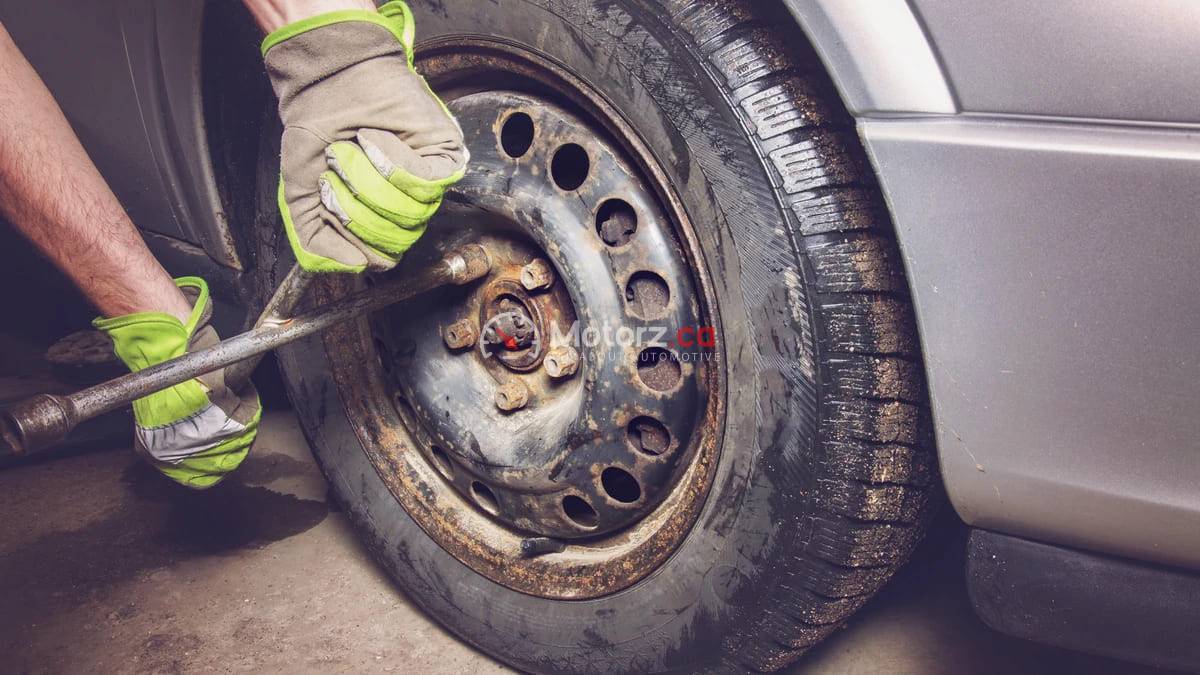
It is the universal sound of a Rusty Bolt Survival Guide project gone wrong: the sharp, metallic snap of a bolt head shearing off. One minute you are performing a simple brake job or swapping out a rusted muffler, and the next, you are staring at a headless stud embedded in your wheel hub. If you live in the “Salt Belt”—stretching from the snowy streets of Toronto and Montreal down through the slushy roads of the Midwest—rusted bolts aren’t just an annoyance; they are a way of life.
In the world of “The Corner Wrench,” we call rust “nature’s welding.” When iron, water, and road salt combine, they create an electrochemical reaction that fuses threads together at a molecular level. Trying to force these fasteners with raw muscle usually leads to rounded edges, broken tools, and a lot of colorful language. In 2026, as vehicles stay on the road longer than ever, mastering the art of the “stuck bolt” is a mandatory skill for any DIYer.
At Motorz, we believe that no bolt is truly permanent if you have the right strategy. Today, Lorraine Explains the science of oxidation, the chemical secrets of penetrating oils, and the mechanical tricks that will turn a “seized” nightmare into a satisfying “click” of success.
Why Rusty Bolt Survival Guide: Understanding the Chemistry of Corrosion
Before you reach for the biggest breaker bar in your toolbox, you need to understand your enemy. Rust (iron oxide) takes up more physical space than the metal it replaces. As a bolt rusts inside a threaded hole, the oxidation expands, creating a massive amount of internal pressure that “locks” the threads in place.
The Galvanic Bond
Often, the problem isn’t just rust, but “galvanic corrosion.” This happens when two different types of metal—like a steel bolt in an aluminum engine block—touch each other in the presence of moisture. This creates a tiny electrical current that essentially “cold-welds” the two metals together. This is why spark plugs in modern aluminum cylinder heads can be so difficult to remove if they haven’t been touched in years.
Road Salt and Brine
Modern road treatments have made the right strategy. In 2026, many municipalities use liquid magnesium chloride brine. This sticky solution clings to your underbody much better than traditional rock salt, finding its way into the tiniest thread gaps and accelerating the corrosion process even during the summer months.
Chemical Warfare: Penetrating Oils and How to Use Them
The biggest mistake most people make is being impatient. If you spray a rusted bolt and immediately try to turn it, you are wasting your time and your money.
The “Wait and See” Strategy
A high-quality penetrating oil—like Liquid Wrench, PB Blaster, or specialized 2026 synthetic formulas—needs time to work. These fluids have an incredibly low surface tension, allowing them to “wick” into gaps as small as a few microns. For a truly seized bolt, you should spray it and wait at least 30 minutes. For suspension bolts, spraying them once a day for three days before you start the job is the Corner Wrench pro move.
The Homemade Secret
If you are out of the store-bought stuff, many old-school mechanics swear by a 50/50 mix of Automatic Transmission Fluid (ATF) and acetone. The acetone acts as a carrier to thin the oil, allowing it to penetrate deep into the rust. Just be careful: this mixture is highly flammable and can damage paint or plastic trim.
The Power of Heat: Using Thermal Expansion to Your Advantage
When chemicals fail, it is time to bring the heat. The goal isn’t to “melt” the rust, but to use the laws of physics to break the bond.
Expanding the Nut
When you heat a nut with a propane or MAPP gas torch, the metal expands. This expansion crushes the rust crystals between the threads. Often, the best technique is to heat the nut until it is glowing dull red, and then immediately touch an old candle or a piece of paraffin wax to the threads. The heat “sucks” the wax into the threads, providing a high-temp lubricant that can help the bolt slide out.
Induction Heaters: The 2026 Standard
If you are working near fuel lines or rubber bushings, an open flame is dangerous. Many modern DIYers are switching to Induction Heaters. These tools use a magnetic coil to heat the metal bolt directly without a flame. It is faster, safer, and much more precise for working in the cramped engine bays of modern vehicles.
Mechanical Advantage: Tools and Techniques for Stubborn Fasteners
If the bolt head is still intact but won’t budge, your choice of tool will determine whether you succeed or strip the head.
Six-Point vs. Twelve-Point Sockets
Never use a 12-point socket on a rusted bolt. A 12-point socket only grips the very corners of the fastener, making it easy to “round off” the bolt. A 6-point socket grips the flat sides of the bolt head, allowing you to apply much more torque without slipping.
Impact vs. Leverage
A long breaker bar provides “static torque,” which is great for breaking things loose, but it can also snap a bolt if the threads are truly fused. An impact wrench provides “kinetic torque”—thousands of tiny, hammer-like blows. This vibration is often much better at shattering the rust bond than a steady pull. If you don’t have an impact wrench, hitting the head of the bolt squarely with a hammer several times (called “shocking” the bolt) can have a similar effect.
When the Worst Happens: Extracting Broken Bolts
If you’ve already snapped the bolt, don’t panic. You still have options before you have to replace the entire component.
Left-Hand Drill Bits
This is the most underrated tool in the shop. A left-hand drill bit is designed to cut while spinning counter-clockwise. Often, as the bit “bites” into the broken stud, the heat and vibration—combined with the reverse rotation—will cause the broken piece to simply unscrew itself and come right out.
Welding a Nut
If there is a small “stub” of the bolt sticking out, you can slide a slightly larger nut over the stub and weld the inside of the nut to the broken bolt. The intense heat from the welder breaks the rust bond, and the new nut gives you a fresh surface to grip with a wrench. This is the gold standard for removing broken exhaust manifold studs.
A Step-by-Step Protocol for Seized Bolts
Next time you encounter a bolt that won’t move, follow the Corner Wrench hierarchy of force:
Clean: Use a wire brush to remove surface rust from the exposed threads.
Soak: Apply penetrating oil and give it time—hours, not minutes.
Shock: Tap the bolt head with a hammer to create microscopic cracks in the rust.
Heat: Use a torch or induction heater to expand the metal.
Turn: Use a 6-point socket and steady, even pressure.
At Motorz, we know that rust is the enemy of progress, but patience is the cure. By combining chemistry, heat, and the right mechanical technique, you can win the war against corrosion. Take your time, protect your knuckles, and remember: if it won’t move, it just hasn’t been “convinced” yet.