

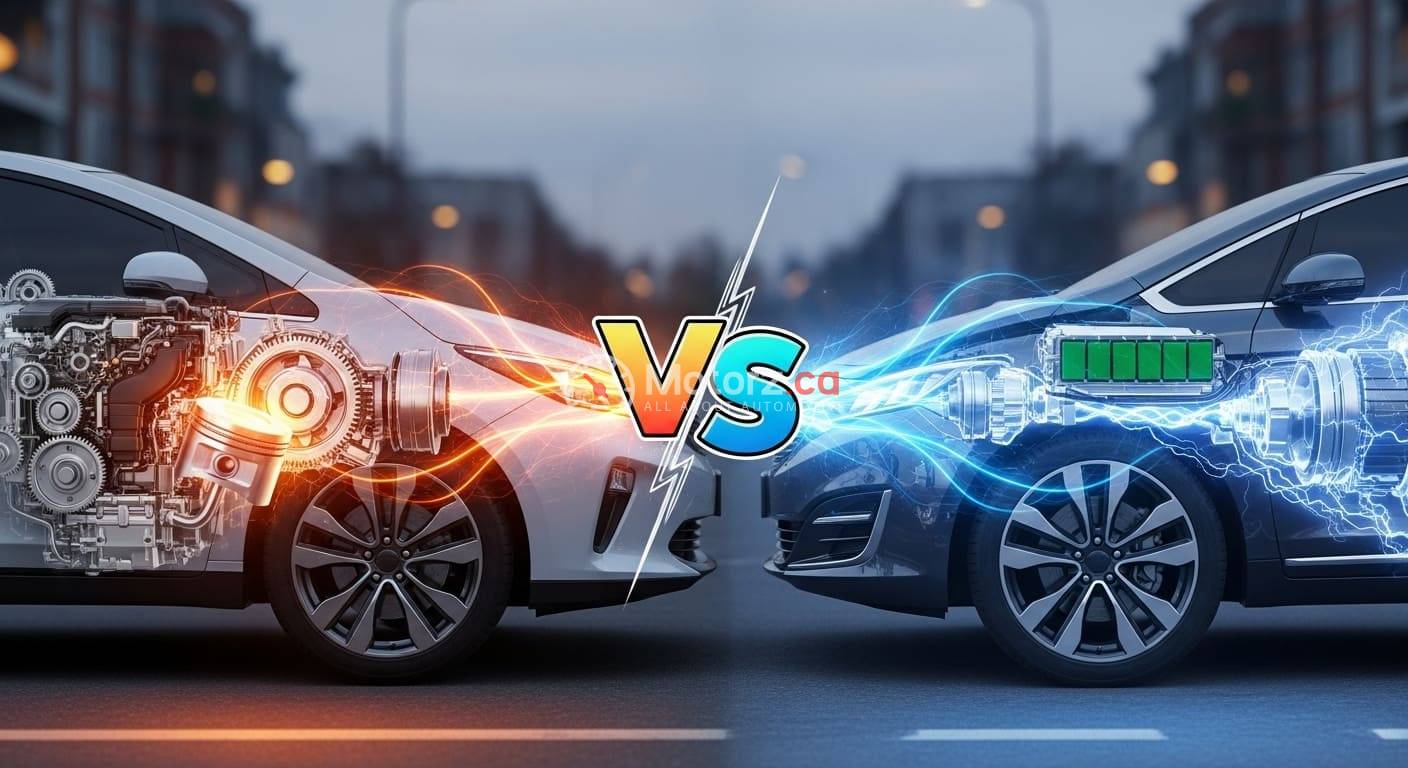

For years, the decision for the environmentally and fiscally conscious Hybrid vs. Electric involved a simple trade-off: Hybrid vehicles (HEVs) offered excellent fuel efficiency without the commitment to charging infrastructure, while pure Battery Electric Vehicles (BEVs) offered freedom from the gas pump but came with a higher upfront price tag.
Today, in the National Capital Region, that choice is far more complex—and far more exciting. Ottawa commuters, driving daily from Kanata, Orléans, Barrhaven, or Gatineau, are uniquely positioned to maximize the savings of both zero-emission vehicles (ZEVs) and efficient hybrids. With fluctuating gasoline Hybrid vs. Electric, relatively cheap Ottawa Hydro rates (especially off-peak), and federal incentives, the financial landscape has shifted dramatically.
The real question isn’t just about the sticker price; it’s about the Total Cost of Ownership (TCO) over the vehicle’s lifespan. This 2000-word ultimate guide dives deep into a head-to-head financial analysis, examining every dollar spent—from the showroom floor to the service bay—to determine whether a hybrid or a fully electric vehicle will save the typical Ottawa driver more money.
Upfront Costs: Incentives Tilt the Scales
The first and most significant hurdle for any new vehicle purchase is the initial sticker price. Historically, hybrids have held a substantial advantage, but government incentives are rapidly closing the gap, particularly for fully electric options.
Comparing MSRP
Generally, a comparable Hybrid vs. Electric will have a lower Manufacturer’s Suggested Retail Price (MSRP) than its Battery Electric Vehicle (BEV) counterpart. This is due to the high cost of the large lithium-ion battery packs required for full electric operation.
Example (Hypothetical Mid-Size SUV):
HEV (e.g., Toyota RAV4 Hybrid): $36,000 – $45,000 CAD
BEV (e.g., Hyundai IONIQ 5 / Chevy Equinox EV): $45,000 – $55,000 CAD
The initial purchase price difference can be $5,000 to $10,000 or more, making the hybrid initially more accessible.
The Impact of Canadian and Provincial Hybrid vs. Electric
This is where the financial script flips. The federal iZEV Program offers up to $5,000 in incentives for eligible BEVs and Plug-in Hybrid vs. Electric (PHEVs).
HEVs (Standard Hybrid): Ineligible for the iZEV rebate.
BEVs (Full Electric): Eligible for the full $5,000 federal rebate.
PHEVs (Plug-in Hybrid): Eligible for a $2,500 to $5,000 rebate, depending on battery range.
Since Ottawa is in Ontario, there are currently no additional provincial rebates, but the federal $5,000 discount significantly offsets the higher Hybrid vs. Electric price. For instance, a $50,000 BEV becomes effectively $45,000, narrowing the gap with a $40,000 HEV to just $5,000.
PHEV: The Middle Ground Purchase
Plug-in Hybrids offer a compelling cost of entry strategy. They qualify for incentives while providing the flexibility of a gasoline engine, appealing to those with range anxiety or limited home charging access. Their upfront cost typically falls between an Hybrid vs. Electric and a BEV after incentives are applied.
Running Costs: Fuel vs. Electricity in Ottawa
This is where the long-term savings are truly realized. The daily cost of the Ottawa commute is fundamentally different for gas and electric vehicles.
The Fuel/Energy Cost Comparison
The difference between paying for gasoline and paying for electricity is the single largest variable in the TCO.
Gasoline (HEV): While hybrids boast exceptional fuel Hybrid vs. Electric (often 4 L/100 km to 6 L/100 km in city driving), they are still subject to the volatility of Ottawa gas prices, which fluctuate constantly (often $1.50 to $1.80 per litre).
Electricity (BEV): Electricity is vastly cheaper and more stable. The average residential Ottawa Hydro rate, particularly for off-peak overnight charging (which is when most EV owners charge), is incredibly competitive.
Cold Weather Impact in Ottawa Winters
Ottawa winters are a crucial consideration. Both drivetrains suffer a performance and efficiency hit, but differently:
HEV in Winter: Fuel consumption increases as the gasoline engine runs more often to heat the cabin and assist the battery in cold v. Fuel savings diminish, but there is no “range anxiety.”
BEV in Winter: EV range can temporarily drop by 20% to 40% in extreme cold (below −15
∘
C) due to battery chemistry and the need for significant cabin heating. However, since the average Ottawa commute is relatively short (often under 50 km round trip), this reduction is often a non-issue, especially with the convenience of home charging and pre-conditioning the car while plugged in.
Maintenance and Repair: Complexity vs. Simplicity
Maintenance is a hidden cost often Hybrid vs. Electric, but it is a major TCO component where BEVs consistently outperform hybrids.
The Complexity of Hybrid Maintenance
Standard Hybrid Electric Vehicles combine a traditional Internal Combustion Engine (ICE) and an electric motor/battery system. This means they require:
Regular oil changes and filter Hybrid vs. Electric (just like a gas car).
Maintenance on all ICE components (spark plugs, belts, exhaust system).
Servicing on the complex hybrid transmission and two separate drive systems.
While HEVs benefit from regenerative braking—which significantly extends the life of brake pads and rotors—they still have more moving parts than a pure Hybrid vs. Electric, leading to more regular, scheduled, and potentially more complex unscheduled maintenance.
The Simplicity of Electric Maintenance
Electric cars are mechanically simpler. They require:
No oil changes, spark plugs, mufflers, or timing Hybrid vs. Electric.
Significantly less brake wear due to regenerative braking.
Routine maintenance is primarily limited to tire rotation, cabin air filters, and wiper fluid.
Over a ten-year ownership period, Hybrid vs. Electric maintenance costs can be 30% to 60% lower than hybrid or gas vehicles. This reduction in time and money spent at the service bay is a massive TCO advantage for the BEV.
The Battery Replacement Factor
The most common counter-argument is the potential cost of battery replacement (often $10,000+). However, modern EV batteries are warranted for 8 years / 160,000 km (and sometimes longer) and are engineered to last the lifespan of the vehicle (often 15+ years). For the typical commuter, this is a negligible risk within the TCO window.
Insurance, Depreciation, and Charging Infrastructure
The TCO analysis must account for the Hybrid vs. Electric, often overlooked, financial factors.
Insurance and Depreciation
Insurance: EV insurance is often higher than hybrid insurance. This is primarily because BEVs have a higher initial value and the battery, the most expensive component, can increase repair costs in the event of a significant accident. This slightly offsets the EV’s running cost savings.
Depreciation and Resale Value: Both EVs and Hybrids generally hold their value better than comparable gasoline-only cars. However, as Hybrid vs. Electric technology rapidly advances (especially battery density and charging speed), early BEV models can experience higher depreciation than established hybrid models (like the Toyota Prius or RAV4 Hybrid). That said, the long-term trend strongly favors ZEVs.
Charging Infrastructure Costs
BEV Charging: To truly maximize cost savings, a BEV owner needs a Level 2 home charger installed. This is an upfront cost (often $1,000 to $2,500, including installation). This investment is essential, as relying solely on public charging stations (especially DC Fast Chargers) significantly raises the cost-per-kilometre, potentially erasing the fuel savings advantage.
HEV Charging: Standard hybrids require zero charging infrastructure—a clear convenience advantage.
For apartment or condo dwellers in downtown Hybrid vs. Electric without guaranteed charging access, the HEV or a PHEV may present a more financially practical solution today, despite the higher fuel costs.
The Plug-in Hybrid (PHEV) Solution: The Best of Both Worlds?
The Plug-in Hybrid Electric Vehicle (PHEV) deserves special attention in the Ottawa context. It represents the financial compromise that works for many.
PHEV Commuter Economics
A PHEV, like the Hyundai Tucson PHEV or Mitsubishi Outlander Hybrid vs. Electric, offers 40 km to 80 km of pure electric range.
For the average Ottawa commute (30 km to 50 km round trip), a PHEV can operate 100% on cheap Ottawa Hydro electricity for most of the year.
This delivers BEV-level running costs for the daily drive.
For longer trips to Toronto or Montreal, the gasoline engine eliminates range anxiety and the need for public charging, saving time and money compared to using expensive DC fast chargers.
The Financial Sweet Spot: A PHEV offers a moderate upfront cost (due to the $2,500-$5,000 incentive), minimal fuel cost for the commute, and the flexibility of traditional refueling for long drives.