It is one of the Windshield Washer Troubles moments in Canadian driving. You are cruising down the highway on a slushy February afternoon, and a passing transport truck kicks up a massive cloud of salty, grey road grime onto your windshield. You are blinded. You instinctively pull the wiper lever, expecting a refreshing blast of blue fluid to clear the path. Instead, you hear a faint, pathetic “whirr” from the motor, and the wipers just smear the mud into a thick, opaque paste.
Suddenly, you are driving a multi-ton vehicle at 100 kilometers per hour with zero visibility.
In this edition of “The Corner Wrench,” we are diving into a system that most drivers ignore until it fails: the windshield washer system. While it might seem like a minor convenience, a functioning washer system is a critical safety component. In 2026, with advanced driver assistance systems (ADAS) relying on cameras mounted behind the glass, a dirty windshield can actually disable your automatic emergency braking or lane-keep assist.
Don’t let a simple clog lead to an expensive repair or a dangerous collision. At Motorz, we are going to show you how to diagnose and fix your washer troubles for pennies, keeping your vision clear and your money in your pocket.
The Anatomy of the Squirt: How the System Works
To fix the system, you first have to understand the path the fluid Canadian driving. It is a simple loop, but a failure at any point will stop the flow.
The Reservoir and the Pump
Everything starts in the plastic tank hidden behind your bumper or fender liner. Attached to the bottom of this tank is a small electric pump. When you pull the lever on your steering column, you se
nd an electrical signal to this pump, which creates pressure to push the fluid through the lines.
The Plumbing: Lines and Check Valves
The fluid travels through thin rubber or plastic hoses. Along this path, there are often small “check valves.” These are one-way gates that prevent the fluid from draining back into the tank when the pump is off. This ensures that you get “instant” spray the moment you pull the lever.
The Nozzles: The Precision Tips
Finally, the fluid reaches the spray nozzles mounted on your hood or the wiper arms. These nozzles are designed to atomize the fluid into a fine mist or a targeted stream that covers the “sweep” of your wiper blades.
Diagnosing the “No-Spray” Scenario
If you pull the lever and nothing happens, use this logical troubleshooting guide to find the culprit.
Step 1: Listen for the Motor
With the engine off but the ignition on, pull the washer lever. Can you hear a faint buzzing or whirring sound coming from the front of the car?
If you hear the buzz: The electrical system and the pump are likely working. The problem is a clog or a broken line.
If it is silent: You likely have a blown fuse, a dead pump, or a broken wire. Check your fuse box first; in 2026 vehicles, this is often a 10-amp or 15-amp fuse labeled “WASH.”
Step 2: Check the Fluid Level (And Type)
It sounds obvious, but check the reservoir. If it is empty, look underneath the car for blue puddles. If the tank is full but it is mid-winter, you might have “summer” fluid that has frozen solid in the lines. This is a common issue we see at The Corner Wrench when people travel from warmer climates to the northern provinces.
Step 3: Inspect the Lines
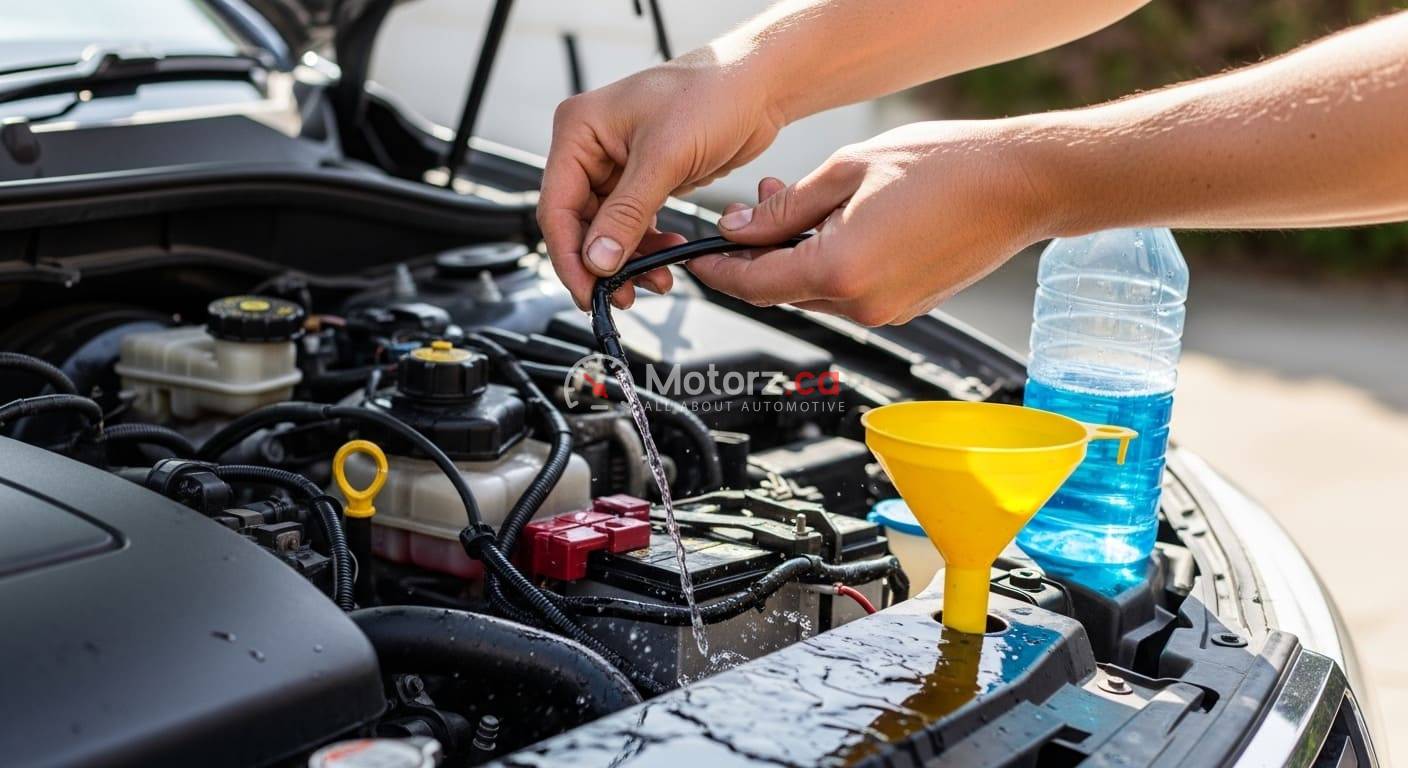
Open the hood and follow the rubber lines from the nozzles back toward the reservoir. Look for “kinks” where the hose might have been pinched by a hood hinge. Also, look for disconnected joints. Sometimes the pressure of a frozen line can pop a hose right off its connector.
The Most Common Fix: Unclogging the Nozzles
Ninety percent of washer troubles are caused by a tiny bit of wax, polish, or road grit stuck in the nozzle tip. You don’t need a mechanic for this; you just need a sewing needle.
The Needle Technique
Gently insert a fine needle or a thin piece of wire into the nozzle opening. Wiggle it around to break up any dried wax or debris. Be careful not to force it, as modern nozzles are often made of plastic and can be easily damaged.
The Compressed Air Blow-Out
If the needle doesn’t work, disconnect the hose from the underside of the nozzle. Use a can of compressed air (the kind used for cleaning keyboards) to blow through the nozzle from the “outside-in.” This pushes the debris back out the way it came rather than forcing it deeper into the system.
Adjusting the Aim
While you are at it, check the aim of your spray. If the fluid is hitting your roof or the bottom of the wipers, you can usually use the same needle to gently pivot the “ball” inside the nozzle to point the spray toward the center of the glass.
Avoiding the “Wallet Washout”: Preventative Maintenance
You can avoid almost all washer failures by making two smart choices during your regular car care routine.
Never Use Just Water
In a pinch, people often fill their reservoir with tap water. This is a mistake for two reasons. First, water has no cleaning agents to cut through road oils. Second, tap water contains minerals that will eventually create “scale” buildup inside your pump and nozzles, leading to a permanent clog that requires component replacement.
Choose the Right Seasonal Fluid
Winter Fluid: Rated for minus 35 or minus 45. These contain high concentrations of methanol to prevent freezing and help melt frost on the glass.
Summer/Bug Fluid: These contain specialized enzymes to dissolve insect remains and tree sap.
The “Year-Round” Trap: Be wary of “all-season” fluids if you live in the Prairies or Northern Ontario. Often, their freezing point isn’t low enough for a true Canadian cold snap.
Clean Your Wiper Blades
Sometimes the “trouble” isn’t the spray, but the wipers. If your blades are coated in oil and grit, the fluid will just bead up and smear. Every time you fill your gas tank, take a damp paper towel and wipe the edge of the rubber blade until the black grime stops coming off.
Clear Vision on a Budget
Your windshield washer system is a simple, reliable part of your vehicle, provided you give it a little attention once or twice a year.
Check the fuse and listen for the motor: Identify if the problem is electrical or mechanical.
Unclog with care: A sewing needle is often the only tool you need to restore full spray.
Use high-quality fluid: Avoid tap water to prevent mineral buildup and freezing.
Inspect the plumbing: Ensure hoses aren’t pinched or disconnected.
At Motorz, we want you to have a clear view of the road ahead. By spending ten minutes in your driveway today, you can avoid the stress of a “blind” drive and keep your repair budget for the big things. Stay safe, stay clear, and keep your “Corner Wrench” handy.