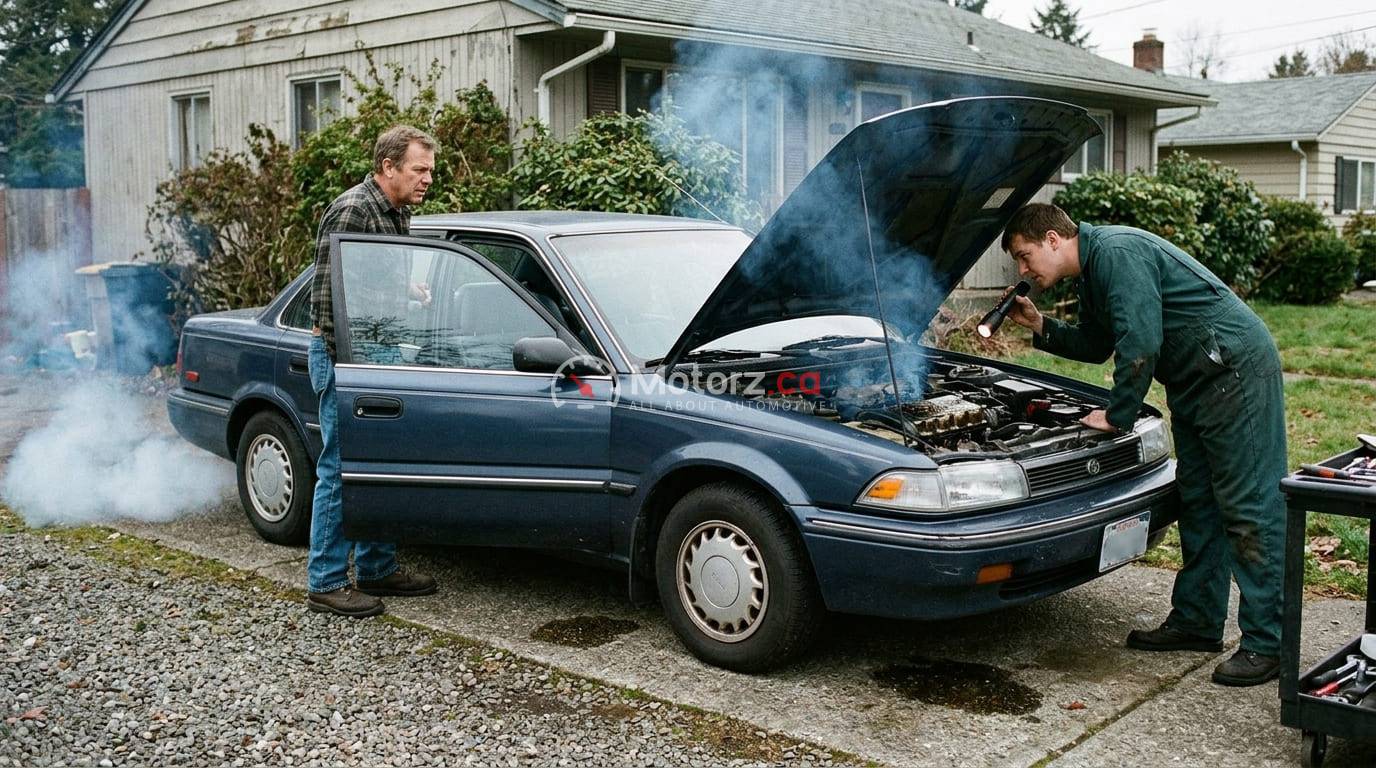
It is one of the most unsettling sights for any Car Burning Oil owner: pulling the dipstick out of the engine and finding it bone dry, or noticing a faint, blue-tinted cloud trailing behind you as you merge onto the highway. You aren’t seeing a puddle on your driveway, yet the oil level continues to drop. Your car is “burning” oil, and while it might feel like the beginning of the end for your engine, it is often a manageable issue—if you catch it early.
In the world of “The Corner Wrench,” oil consumption is a topic that brings in dozens of questions every month. In 2026, modern engines are designed with tighter tolerances and thinner oils to maximize fuel efficiency, but this also makes them more sensitive to oil loss. When your engine starts consuming its own lifeblood, it’s not just an inconvenience; it’s a warning sign that internal components are wearing out or struggling to breathe.
At Motorz, we want to take the mystery out of the clouds of smoke. Today, Lorraine Explains why cars burn oil, the difference between a minor leak and a major internal failure, and the exact steps you should take to protect your engine from a catastrophic breakdown.
How to Tell if Your Car Burning Oil
Before you panic, you need to confirm that the Car Burning Oil is actually being burned inside the engine rather than leaking out of a gasket onto the ground.
The Dipstick Test
The most reliable method is consistent monitoring. Check your oil every second time you fill up with fuel. If the level drops from the “Full” mark to the “Add” mark over the course of 1,000 kilometers, and there are no wet spots on your parking space, your engine is likely consuming the oil internally.
The Blue Smoke Signal
Keep an eye on your rearview mirror during specific driving conditions.
Smoke during acceleration: This usually points to worn piston rings.
Smoke after idling or at startup: This is a classic sign of leaking valve stem seals. Note that “burning oil” smoke is distinctly blue or grey. White smoke is usually coolant (a separate issue), and black smoke is usually an over-abundance of fuel.
The “Burning” Smell
Oil that escapes the internal combustion chamber but drips onto a hot exhaust manifold will produce a sharp, acrid smell. While this is technically a leak, it often smells like the car is “burning,” providing a vital clue that a gasket has failed.
Common Causes of Oil Consumption
Modern engines are complex, and oil can find its way into the combustion chamber through several different “gateways.”
Worn Piston Rings
Piston rings act as a seal between the piston and the cylinder wall. Their job is to keep the oil in the crankcase and the combustion gases in the cylinder. As they wear down or get “stuck” due to carbon buildup, they can no longer scrape the oil off the cylinder walls effectively. This leftover oil is then burned during the next explosion in the engine.
Faulty PCV (Positive Crankcase Ventilation) Valve
The PCV valve is a simple, inexpensive component that manages engine gases. If it becomes clogged or stuck open, it can create a vacuum that literally sucks oil out of the engine and into the intake manifold, where it is burned. At “The Corner Wrench,” we always check the PCV valve first because it is a 20-unit fix that can solve a seemingly massive problem.
Leaking Valve Stem Seals
Valves at the top of your engine open and close thousands of times per minute. Small rubber seals keep the oil that lubricates the top of the engine from sliding down the valve stems and into the combustion chamber. When these seals harden or crack, oil seeps down while the car is parked, leading to that characteristic puff of blue smoke when you first start the car in the morning.
The Risks of Ignoring Oil Consumption
Some drivers think they can simply “keep adding oil” and avoid a repair bill. While this works in the short term, “feeding the beast” can lead to much more expensive secondary failures.
Catalytic Converter Failure
Your catalytic converter is designed to scrub exhaust gases, not liquid oil. As burned oil residue passes through the exhaust, it coats the precious metals inside the converter with a “glaze” of phosphorus and ash. This will eventually clog the converter, leading to a “Check Engine” light and a repair bill that can easily exceed 1,500 units.
Spark Plug Fouling
When oil enters the combustion chamber, it coats the spark plugs in a black, oily soot. This prevents the plug from sparking correctly, leading to engine misfires, poor fuel economy, and a lack of power. If your car feels like it is “stuttering,” your burning oil problem has already started affecting your performance.
Total Engine Failure
This is the ultimate risk. If you forget to check the oil for a few weeks and the level drops too low, the metal components inside your engine will no longer have a protective film. The resulting friction creates intense heat, which can “weld” the engine parts together in seconds, effectively destroying the vehicle.
Immediate Steps: What to Do Now
If you have confirmed your car is burning oil, follow this protocol to minimize damage.
Switch to a High-Mileage Oil
If your car has over 120,000 kilometers, consider switching to a “High Mileage” synthetic oil. These oils contain special “seal swellers” and conditioners that can help re-hydrate old rubber gaskets and valve seals, potentially slowing down the consumption rate without a mechanical teardown.
Use an Engine Flush or Cleaner
Sometimes piston rings are simply “stuck” due to carbon deposits from long oil change intervals. A high-quality engine flush added before your next oil change can help dissolve these deposits and allow the rings to move freely again, restoring their sealing ability.
Increase Oil Viscosity (With Caution)
In some older engines, moving from a thin 0W-20 oil to a slightly thicker 5W-30 (if allowed by the manufacturer) can reduce the amount of oil that slips past worn seals. Always check your owner’s manual before changing oil weights, as modern engines with variable valve timing are very sensitive to thickness.
Managing the Life of Your Engine
An oil-burning engine isn’t necessarily a death sentence, but it is a call to action. By staying proactive, you can keep your car on the road for many more years.
Monitor Closely: Check your oil level every 500 to 1,000 kilometers and keep a log.
Fix the Easy Stuff: Replace the PCV valve and check for external leaks first.
Protect the Exhaust: Don’t ignore blue smoke; it will eventually destroy your catalytic converter.
Choose the Right Oil: Use high-mileage formulas to support aging seals.
Never Run Dry: The cheapest insurance is a 10-unit bottle of oil in the trunk to top off the level as needed.
At Motorz, we want to see you hit that 300,000-kilometer milestone. Understanding why your car is burning oil is the first step in taking control of your vehicle’s health. Whether you are driving a classic truck or a modern hybrid, keep the oil full, keep the seals soft, and listen to what your engine is trying to tell you.