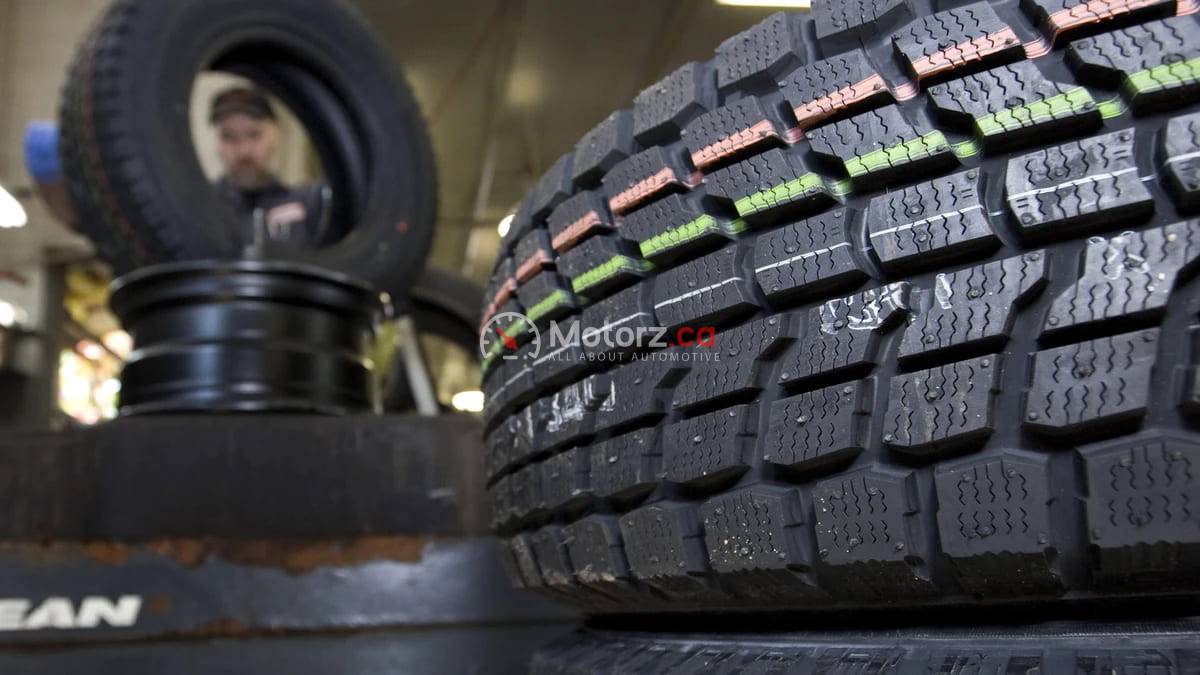
The snow is starting to fall in Calgary, the slush is freezing over in Montreal, and you are staring at your bank account. You know you need winter tires, but a full set of four high-quality “shoes” for your car is a significant investment. Then, a thought occurs: “My car is front-wheel drive. If I just put two winter tires on the front for traction, that should be enough to get me through, right?”
In the world of “The Corner Wrench,” this is one of the most dangerous myths we encounter every single year. It seems logical—put the grip where the power is. But in reality, running just two winter tires is a recipe for a mechanical disaster that can send you spinning into the ditch before you even realize you’ve lost control.
In 2026, with advanced stability control systems and All-Wheel Drive (AWD) becoming the norm, the “two-tire” mistake is actually more dangerous than it was twenty years ago. Today, we are breaking down the physics of “mismatched traction,” why your car’s computer will hate you for it, and why four winter tires are the only safe way to navigate a Canadian winter.
The Physics of the “Spin-Out”: Understanding Mismatched Traction
When you put winter tires on only one axle, you Winter Tires just saving money; you are creating a vehicle with two completely different personalities. One end of your car wants to grip the road, while the other end wants to act like a hockey puck.
The Oversteer Nightmare
If you put your winter tires on the front of a front-wheel-drive car, you will have great traction for accelerating and steering. This gives you a false sense of security.
The Physics: When you enter a curve on an icy road, the front of the car grips and begins to turn. However, the rear tires (which are likely all-seasons) have no lateral grip. Because the front is “anchored” and the rear is “loose,” the back of the car will swing around like a pendulum.
The Result: This is called “oversteer,” and for most drivers, it is almost impossible to correct on ice. You end up facing backward in your own lane—or worse, in oncoming traffic.
The Understeer Struggle
Some people think putting winter tires on the rear of a rear-wheel-drive car is the solution. While this helps you get moving, it creates the opposite problem.
The Physics: When you turn the steering wheel to go around a corner, your front all-season tires will simply slide straight forward.
The Result: This is “understeer” or “plowing.” Even though your rear wheels are pushing you forward, your front wheels have lost the ability to guide the car.
Fighting the Machine: Why Your Car’s Tech Can’t Save You
Modern 2026 vehicles are packed with safety tech like Electronic Stability Control (ESC) and Anti-lock Braking Systems (ABS). But these systems rely on a critical assumption: that all four tires have roughly the same amount of grip.
Confusing the ESC Sensors
Your car’s computer constantly monitors the speed of each wheel. If it detects that the rear wheels are spinning at a different rate or sliding while the front wheels are gripping, it will try to intervene by applying the brakes to individual wheels.
The Conflict: If you have mismatched tires, the computer receives “conflicted” data. It may apply the brakes in a way that actually worsens a skid because it cannot account for the massive difference in friction between the front and rear axles.
ABS and Braking Instability
During a panic stop on slushy pavement, your ABS is designed to keep your wheels from locking up. If your front tires have winter grip and your rears do not, the front will handle most of the braking force. This shifts the weight of the car forward aggressively, making the “loose” rear end even lighter and more likely to fishtail.
The “Rubber” Problem: It’s Not Just About the Tread
A common point of confusion we hear at Motorz is that people think winter tires are only about the “deep grooves” for snow. It is actually about the chemistry of the rubber.
The Glass Transition Point
All-season rubber is designed to work in a wide range of temperatures, but it begins to harden and lose its “stickiness” once the temperature drops below 7 Celsius. By the time it hits minus 10, all-season rubber is as hard as a hockey puck.
The Contrast: Winter tires are made with high-silica compounds that stay soft and pliable even at minus 30.
If you have two soft tires and two hard tires, your car’s handling becomes unpredictable. As the temperature drops, the “traction gap” between your two axles grows wider, making the car increasingly unstable even on dry, cold pavement.
The Legal and Insurance Implications in Canada
In 2026, the “two-tire” setup isn’t just a safety risk; it can be a legal and financial one too.
Quebec and Beyond
In Quebec, the law is clear: all four tires must be winter-certified (with the Three-Peak Mountain Snowflake symbol) from December 1 to March 15. If you are caught with only two, you face heavy fines. While other provinces like Ontario or British Columbia may not have a “total mandate” for all roads, having mismatched tires can impact your insurance.
The Insurance “Denied Claim” Risk
Lorraine Complains frequently about insurance loopholes, and this is a big one. If you are involved in a winter accident and the adjuster discovers you had mismatched tires, they could argue that the vehicle was “mechanically unfit” or that you were negligent in maintaining a safe vehicle. This could potentially lead to a denied claim or a significant increase in your “at-fault” rating.
Four or None
At “The Corner Wrench,” our stance is firm: Winter safety is an all-or-nothing game. If you cannot afford four new winter tires, look into high-quality used sets from a reputable dealer or consider a “budget-friendly” tier of four winter tires rather than two “premium” ones.
Consistency is key: All four tires need to work together to keep the car balanced.
Safety tech needs help: Your ABS and ESC systems require uniform traction to function correctly.
Protect your investment: Four winter tires will last twice as long as two because you can rotate them properly, ensuring even wear.
Don’t let a “half-measure” turn into a full-scale accident. Equip your vehicle with a full set of four winter tires and give yourself the grip you need to handle whatever a Canadian winter throws your way.