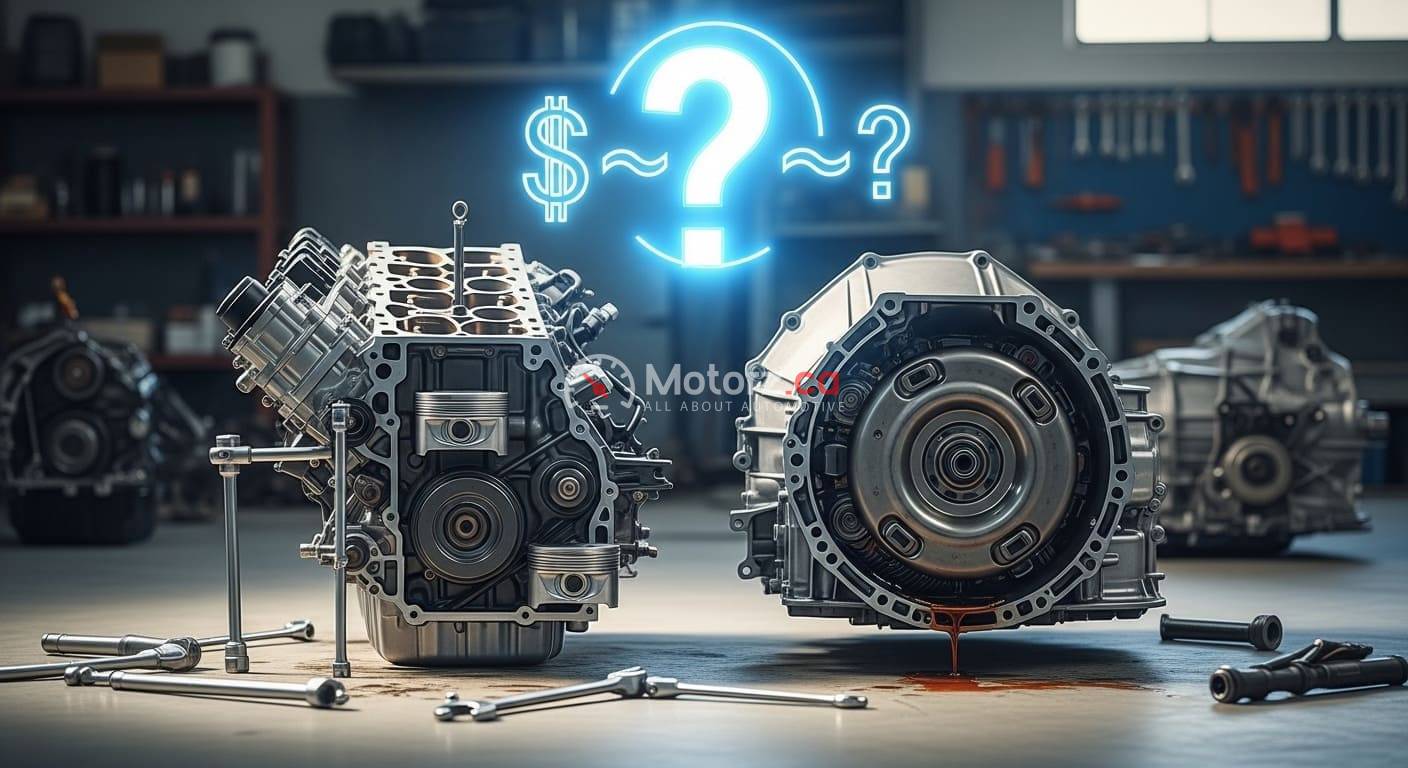
It is the phone call every Engine and Transmission. You left your car at the shop because of a strange noise or a slipping gear, and now your mechanic is on the line with a heavy sigh. The diagnosis is in: your engine or transmission has suffered a major failure. Suddenly, you are standing at a crossroad. Do you pay for a complex, labor-intensive repair? Do you swap the entire unit for a new or used one? Or is it time to cut your losses and go car shopping?
In the world of “The Corner Wrench,” this is the ultimate test of automotive logic. In 2026, as vehicle prices remain high and the cost of labor continues to climb, the math behind “repair vs. replace” has shifted. What made sense five years ago might be a financial mistake today.
Today, is breaking down the hard facts of drivetrain surgery. We will look at the internal anatomy of these failures, the hidden costs of “rebuilding,” and the strategic ways to decide if your car is worth saving. Whether you are dealing with a blown head gasket or a shattered CVT, here is how to navigate the most expensive decision in car ownership.
Engine and Transmission: To Fix or to Swap?
The engine is the heart of your vehicle. When it fails, the “fix” can range from a simple sensor to a complete internal meltdown.
When to Choose Repair
Repairing an engine is usually the best path when the failure is Engine and Transmission or external. If the core of the engine—the block, crankshaft, and pistons—is still healthy, a repair is often the most cost-effective solution.
Head Gaskets: If your car overheated and blew a gasket but you stopped driving immediately, replacing the gasket and machining the cylinder head is a standard, successful repair.
Timing Chains and Belts: If the belt broke but the engine is a “non-interference” design (meaning the valves didn’t hit the pistons), replacing the timing components is a no-brainer.
Oil Leaks: Most external leaks, even rear main seals, are worth repairing to keep a high-quality engine running for another 100,000 kilometers.
When to Choose Replacement
When the “bottom-end” fails, the conversation changes. If you hear a deep, rhythmic knocking (rod knock) or if the engine has “seized” due to a lack of oil, the internal damage is likely catastrophic.
The Cost of Machining: Rebuilding an engine in 2026 requires a specialized machine shop to bore the cylinders and polish the crank. By the time you pay for the machine work, the new pistons, the gasket kit, and the 20 plus hours of mechanic labor, you are often well over the cost of a “crate” engine or a low-mileage used unit.
Remanufactured Engines: A “reman” engine comes with a warranty (often 3 years or 160,000 km) and has been rebuilt in a controlled factory environment. For many, this peace of mind is worth more than a local repair.
The Transmission Dilemma: Shifting Toward a Solution
Transmissions are the most complex mechanical components in a modern car. In 2026, the rise of CVTs and 10-speed automatics has made “repairing” them a lost art.
The Problem with Modern Rebuilds
In the past, a local transmission shop could “overhaul” a three-speed automatic in a day. Today, a modern transmission contains hundreds of tiny valves, sophisticated electronics, and incredibly tight tolerances.
The Parts Gap: Often, the internal parts for the newest transmissions aren’t even sold to independent shops; the manufacturer only sells the entire unit.
Specialized Tools: Modern transmissions often require proprietary software to “re-learn” shift points after a repair. If your local shop doesn’t have the 2026 factory scan tools, the repair may never feel right.
The Used Transmission Shortcut
For an older vehicle, a used transmission from a reputable salvage yard is often the only way to make the math work. At “The Corner Wrench,” we recommend searching for a unit with documented mileage. If the labor to install it is relatively low (4 to 6 hours), a used unit can get you back on the road for a fraction of the cost of a rebuild.
The 50 Percent Rule: Does the Math Work?
At Motorz, we use a simple formula to help drivers decide. We call it the 50 Percent Rule.
If the cost of the repair or replacement exceeds 50 percent of the actual market value of the car, it is time to consider a trade-in.
Example: Your 2017 sedan is worth 10,000. The transmission replacement quote is 6,000. You are at 60 percent of the car’s value. Unless the car is in pristine condition and you plan to drive it for another five years, this is a “total loss” in mechanical terms.
The “Value” Trap: Remember, spending 6,000 to fix a 10,000 car does not make it a 16,000 car. It is still a 10,000 car—it just happens to work now.
Hidden Costs: Don’t Forget the “While You’re in There” Factor
When you replace an engine or transmission, the bill you see on the screen isn’t the final number. To do the job right, you must account for the peripheral components.
The Engine Refresh List
If you are putting in a replacement engine, you should almost always replace:
The Water Pump and Thermostat: They are easy to reach while the engine is out.
The Motor Mounts: If they are cracked, now is the time.
The Clutch (for manuals): You’ll never have a better opportunity.
The Transmission Cooling System
When a transmission fails, it often sends metal shavings into the cooling lines and the radiator. If you don’t flush the lines or replace the transmission cooler when you install the new unit, those old metal shavings will fly right into your new transmission and destroy it within a week.
Making the Final Call
Deciding whether to repair or replace is about balancing your current budget against your future needs.
Get a detailed quote: Know exactly what failed and why.
Check the market: Use online tools to see what your car is actually worth in its current state versus a working state.
Consider the warranty: A repair might only have a 90-day warranty, while a remanufactured unit could protect you for years.
Trust your gut: If the car has been a “lemon” with constant electrical and suspension issues, a new engine won’t change its personality. It might be time to move on.
At Motorz, we know that these are the “heavy” moments of car ownership. But by staying informed and using the Corner Wrench logic, you can turn a mechanical crisis into a smart financial pivot.